
Anti-Drone Systems: How Counter-UAS Solutions Detect and Track Drones
Anti-drone systems, also called counter-UAS (C-UAS) systems, protect military bases, airports, borders, critical infrastructure and events against unauthorised or hostile drones. Small drones are cheap, fast and hard to see, so a counter-drone solution has to detect them early, confirm what they are and follow them precisely until the threat is handled. This article explains the main layers of an anti-drone system and the role of electro-optical sensors and pan tilt positioners.
Why Drones Are Hard to Counter
- Small size: a small drone has a very small radar and visual signature.
- Low altitude and speed changes: drones fly close to the ground, hover and change direction quickly.
- Clutter: birds, trees and buildings create false alarms.
- Many directions: threats can come from any direction, including almost directly overhead.
The Layers of a Counter-UAS System
1. Detection
Radar designed for small, slow targets, radio frequency (RF) detectors that sense drone control and video links, and sometimes acoustic sensors provide the first warning and an approximate position.
2. Tracking and identification
The detection sensors cue an electro-optical (EO) unit with a day camera and a thermal camera. The operator, often supported by video analytics, confirms whether the object is a drone, a bird or an aircraft, identifies the drone type and checks for a payload. Continuous video tracking provides an accurate bearing and elevation to the target.
3. Neutralisation
Depending on the user and the legal framework, responses range from RF jamming and navigation signal disruption to interceptor drones, nets, lasers or kinetic effectors such as remote controlled weapon systems. All of them depend on accurate pointing at the target.
4. Command and control
Software fuses radar, RF and EO data on a single map, manages alarms and records events, and allows one operator to supervise several sensors.
The Role of the Pan Tilt Positioner
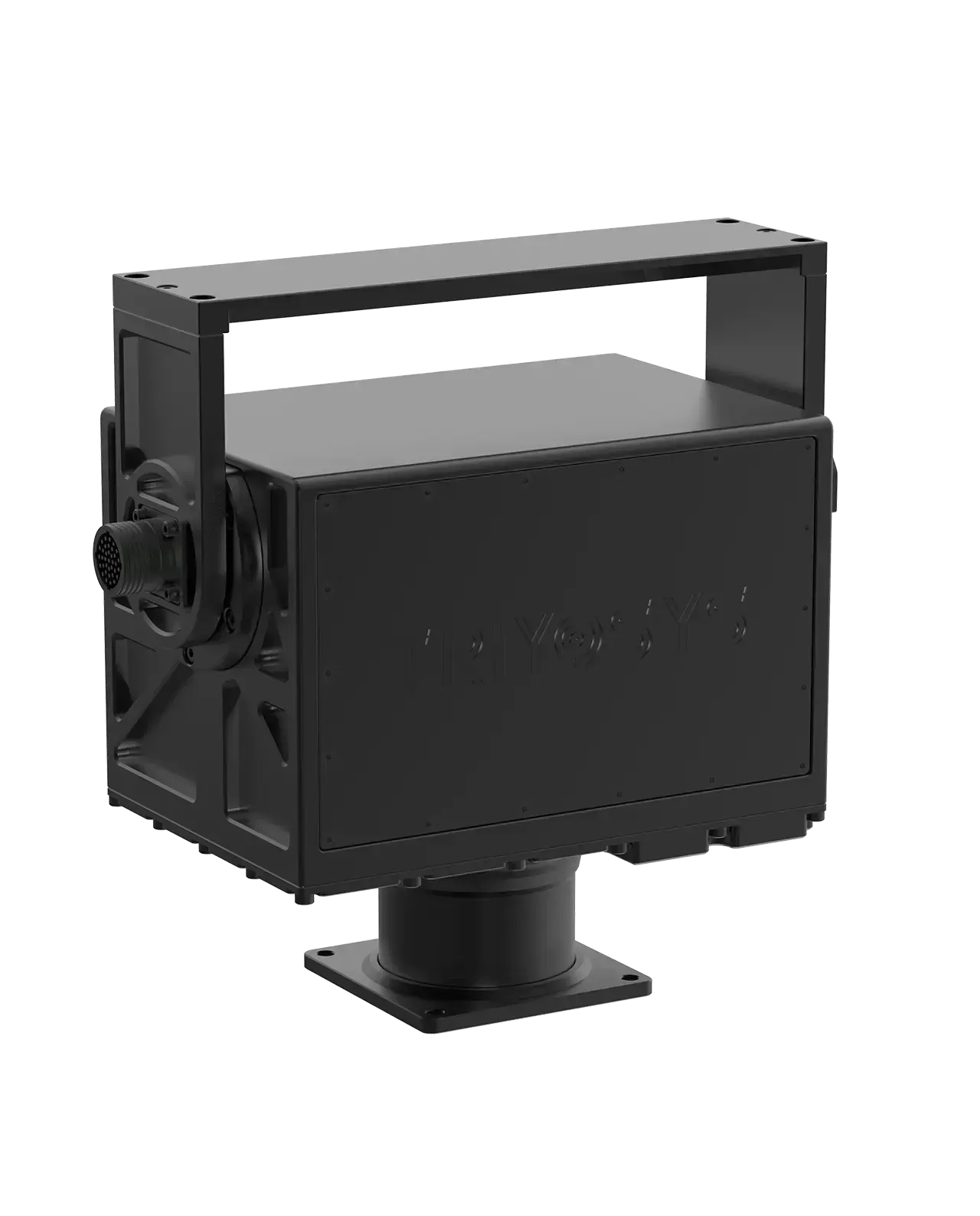
The EO sensors, and in many systems the jammer antennas or effectors, are carried on motorized pan and tilt units. In counter-drone applications the positioner has to meet demands that are higher than in classic perimeter surveillance:
- High speed and acceleration to slew quickly to a radar cue and keep up with a fast crossing drone. High-speed, high-torque positioners such as the MPT-EO Series are designed for this kind of dynamic task.
- Wide tilt range: unlike ground surveillance, the sensor may need to look almost straight up.
- Smooth low-speed motion for stable video when tracking a hovering drone with a narrow field of view.
- Accuracy and repeatability so that the reported direction is reliable for hand-over to effectors.
- Stabilization for mobile and naval systems; gyro stabilized positioners such as the MPT-U Series with Gyro Stabilization compensate for vehicle or ship motion.
- Payload capacity for heavier combinations of cameras, laser range finders and antennas.
Our guide How to Choose a Pan Tilt Unit explains these criteria in more detail.
Fixed, Mobile and Naval Anti-Drone Systems
Fixed installations protect bases, airports and critical facilities around the clock. Vehicle-mounted systems move with convoys or are deployed for temporary events, and naval systems protect ships and ports. Anti-drone sensors are also increasingly integrated into border surveillance systems.
Environmental Requirements
Like other defense equipment, counter-drone systems operate outdoors around the clock. High IP protection, testing to standards such as MIL-STD-810, wipers for clear optics and humidity control units help ensure availability in rain, dust and temperature extremes.
TRIYOSYS for Counter-UAS Applications
TRIYOSYS designs and manufactures high-speed and stabilized pan tilt units, operator control units and surveillance systems that can serve as the pointing and tracking platform of anti-drone solutions, in Ankara, Türkiye. Contact our team to discuss the requirements of your counter-UAS project.