

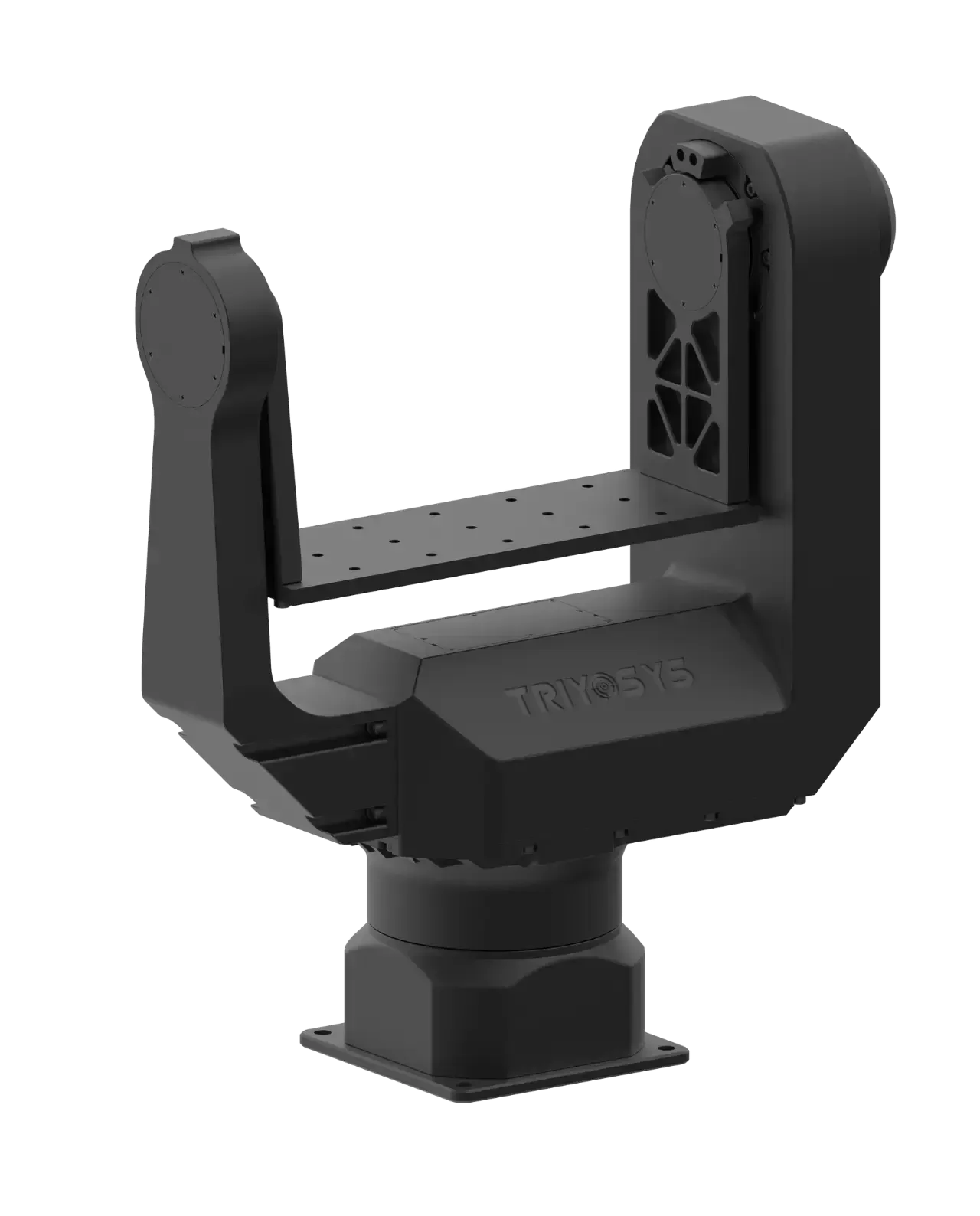
When a camera or sensor is mounted on a moving vehicle, a ship or a tall mast, every bump, wave and gust of wind moves its line of sight. At long range, even a tiny angular movement shifts the image by meters. Gyro stabilization solves this problem: it measures the motion of the platform and drives the pan tilt unit in the opposite direction so that the sensor stays pointed at the target. This article explains how stabilized pan tilt units work and what to consider when choosing one.
Why Is Stabilization Needed?
The required stability depends on the field of view of the sensor. A wide-angle camera tolerates some movement, but a long-range zoom or thermal camera with a narrow field of view turns small platform vibrations into a shaking, unusable image. Typical sources of disturbance are:
- Vehicle motion: rough terrain, braking and turning
- Ship motion: roll, pitch and yaw caused by waves
- Mast sway: wind loads on telescopic masts and towers
- Vibration: engines, generators and weapon firing
How Does Gyro Stabilization Work?
- Sensing: gyroscopes (and often accelerometers) measure the angular rate of the platform or of the payload itself.
- Control: a control algorithm calculates the correction needed to keep the line of sight fixed in space.
- Actuation: the pan and tilt motors move in the opposite direction of the disturbance, many times per second.
- Tracking: operator commands or a video tracker are added on top of the stabilization loop, so the sensor can follow a target while remaining stable.
Stabilization accuracy is usually expressed in milliradians (mrad). For example, the MPT-U Series with Gyro Stabilization offers ±1 mrad stabilization accuracy.
Mechanical Design Matters
Good stabilization starts with mechanics. Low backlash in the gears, high stiffness, a balanced payload with its center of gravity close to the rotation axes, and motors with enough torque and bandwidth all improve stabilization performance. A poorly balanced or flexible system forces the control loop to work harder and limits the achievable accuracy.
Where Are Stabilized Pan Tilt Units Used?
- Naval and coastal surveillance on ships and patrol boats
- Vehicle-mounted surveillance and observation on the move
- Mobile surveillance systems on masts
- Remote controlled weapon systems and fire control
- Anti-drone systems that track fast targets
How to Choose a Stabilized Pan Tilt Unit
- Define the platform (vehicle, ship, mast) and its typical motion.
- Define the narrowest field of view of your sensors; this sets the required stabilization accuracy.
- Check the payload capacity and balance of the full sensor package.
- Check speed and acceleration for target tracking.
- Check environmental protection and interfaces for your system.
For general selection criteria see How to Choose a Pan Tilt Unit. TRIYOSYS designs and manufactures stabilized and non-stabilized motorized pan and tilt units in Ankara, Türkiye; contact us to discuss your application.