

Vehicle-Mounted Surveillance Systems: Components and Design Considerations
Vehicle-mounted surveillance systems turn armoured vehicles, pickups, vans and trailers into mobile observation posts. They carry long-range cameras and radar to wherever they are needed, raise them above terrain and obstacles, and can be operational within minutes. They are used for border patrol, base and convoy protection, reconnaissance, critical infrastructure security and temporary events. This article explains how these systems are built and what to consider when designing one.
Where Vehicle-Mounted Systems Are Used
- Border and coastal patrol: filling gaps between fixed towers and reacting to changing activity.
- Reconnaissance and surveillance vehicles: observing an area from a safe distance.
- Base, camp and convoy protection: perimeter monitoring during temporary deployments.
- Critical infrastructure and events: rapid security coverage for pipelines, construction sites or public events.
Main Components
Sensor payload
A typical payload combines a long-range day camera, a thermal camera and a laser range finder; many systems add a ground surveillance radar that cues the cameras. The payload is chosen according to the required detection, recognition and identification ranges.
Pan tilt positioner
The sensors are mounted on a motorized pan and tilt unit that points them precisely and tracks targets. For observation while the vehicle is moving, or when the mast sways in the wind, a stabilized positioner such as the MPT-U Series with Gyro Stabilization keeps the line of sight steady.
Mast
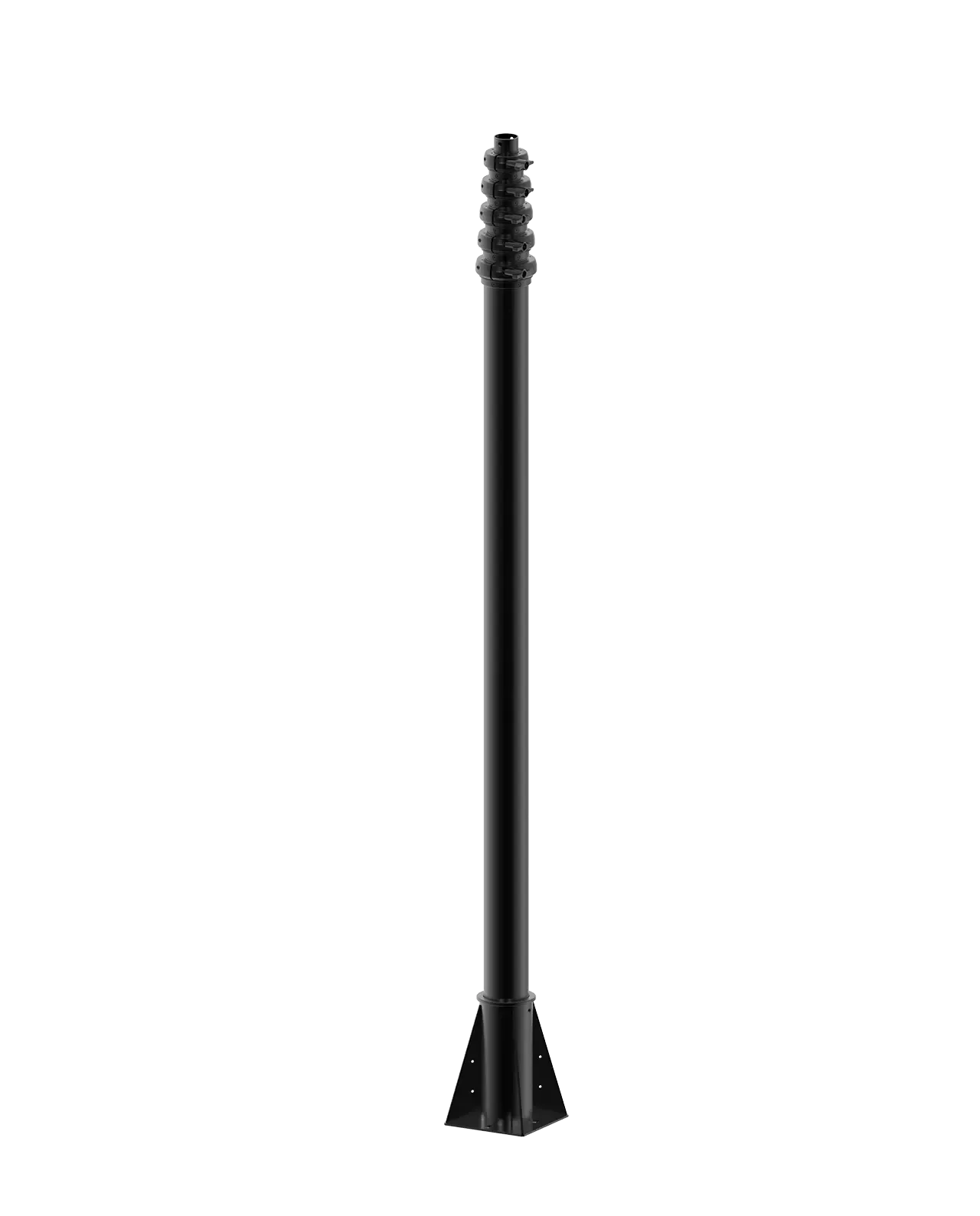
Height is what makes a vehicle a useful observation post: raising the sensors a few metres extends the line of sight over vegetation, walls and terrain. Mast systems, from manually extended telescopic masts to motorized pneumatic or mechanical masts, are selected by height, payload capacity, deployment time and stiffness against wind.
Control, power and communication
Operators work from inside the vehicle with a rugged operator control unit or a remote command centre. Power comes from the vehicle battery, an auxiliary battery pack or a generator, so energy consumption matters for silent watch. Video and data can be shared over radio, cellular or satellite links.
Optional equipment
Lighting systems for illumination and signalling and remote controlled weapon solutions can be integrated on the same vehicle and slaved to the surveillance sensors.
Design Considerations
- Deployment time: how quickly the system must go from transport to operation, including mast extension and sensor start-up.
- Mast height and stability: taller masts see further but sway more in wind; stiffness and stabilization must match the camera field of view.
- Weight and centre of gravity: the payload and mast affect vehicle handling and must be within the vehicle's limits.
- Shock and vibration: off-road driving loads equipment heavily; components should be designed and tested for vehicle use, typically to MIL-STD-810.
- Stowed position: sensors and masts must be locked securely for transport and protected from branches and impacts.
- Environment: dust, rain and temperature extremes require high IP protection; wipers and humidity control units keep optics clear and electronics dry.
- Power budget and silent watch: how long the system must run with the engine off.
- Integration: standard interfaces make it easier to connect the system to command-and-control networks.
Our guide How to Choose a Pan Tilt Unit covers positioner selection in more detail.
Vehicle-Mounted, Fixed and Portable Systems
Vehicle-mounted systems are most effective as part of a layered solution together with fixed towers and portable systems on tripods. Read more about this approach in Border Surveillance Systems and, for ships and coastal sites, Naval Surveillance Systems.
TRIYOSYS Mobile Surveillance Solutions
TRIYOSYS designs and manufactures pan tilt units, mast systems, tripods and the Mobile Surveillance System, a rapidly deployable platform with a stabilized pan tilt unit and multi-sensor payload, in Ankara, Türkiye. Contact our team to discuss your vehicle integration project.