

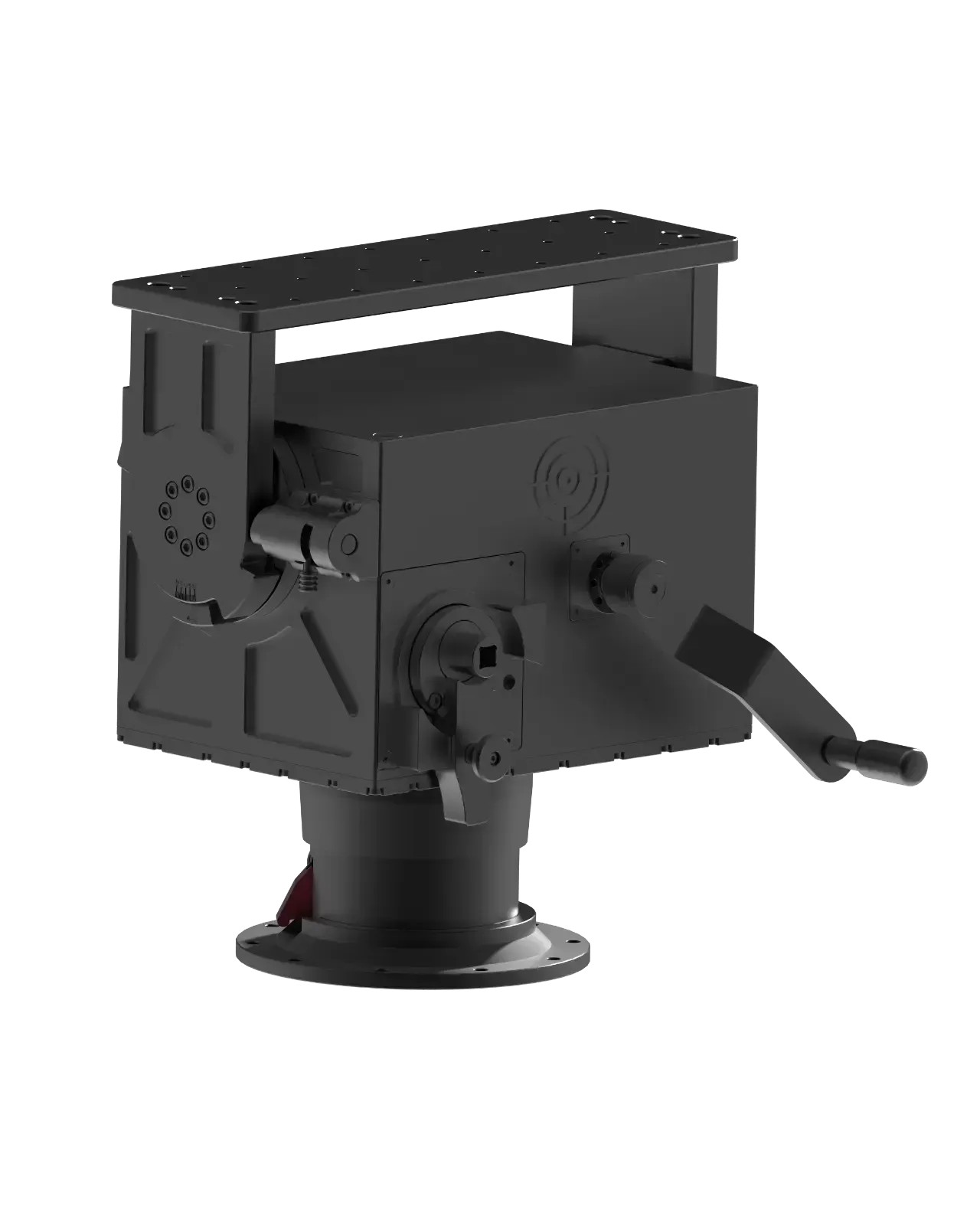
How to Choose a Pan Tilt Unit: 9 Criteria for Surveillance and Defense Systems
A pan tilt unit (also called a pan tilt positioner or PTZ positioner) rotates a camera or sensor payload horizontally (pan) and vertically (tilt). In surveillance and defense systems, it decides where the sensors look, how fast they react and how stable the image is. Choosing the wrong unit leads to shaky images, slow target tracking or early failures in the field. This guide explains the nine criteria to check before selecting a pan tilt unit.
1. Payload Capacity and Center of Gravity
Start with the total weight of everything the unit will carry: cameras, thermal imagers, laser range finders, illuminators, housings, cables and brackets. Then look at how this weight is distributed. A payload whose center of gravity is far from the rotation axes creates a large torque, especially on the tilt axis. Always choose a unit whose rated capacity leaves a safety margin above your real payload and check whether the rating is given for a centered or offset load.
Payload configuration also decides the design: top-mount units carry the payload above the positioner, while side-mount (yoke type) units hold sensors on one or both sides and allow very large tilt ranges.
2. Speed and Acceleration
Fast pan speed helps a unit slew quickly to an alarm location. Smooth low-speed control is just as important: when a long-range camera is zoomed in, even small jerks make the target jump on screen. Look at the maximum speed, the minimum controllable speed and the acceleration of both axes.
3. Positioning Accuracy, Repeatability and Resolution
For long-range surveillance, a small angular error becomes a large distance at the target. Check the positioning accuracy (how close the unit gets to the commanded angle), repeatability (how consistently it returns to the same preset) and resolution (the smallest step it can make). Low backlash in the gear train is essential for precise tracking.
4. Rotation Range
Continuous 360° pan rotation, usually achieved with a slip ring, lets the unit follow a target all the way around without unwinding cables. Check the tilt range as well: border towers often need small tilt angles, while air defense or anti-drone applications may need the sensor to look almost straight up.
5. Environmental Protection
Outdoor and military systems face rain, dust, salt fog, ice, heat and vibration. Check the following:
- IP rating: IP66 or IP67 is common for outdoor positioners.
- Operating temperature range: including cold start and heaters if needed.
- Environmental test standards: such as MIL-STD-810 for shock, vibration, humidity and salt fog.
- Corrosion protection: surface treatments and materials suitable for coastal and naval use.
Accessories such as wipers and humidity control units help keep optics clear and electronics dry.
6. Electromagnetic Compatibility
On military vehicles, ships and command posts, the pan tilt unit must not disturb other equipment and must keep working in strong electromagnetic fields. Units intended for these platforms are usually tested to standards such as MIL-STD-461.
7. Stabilization for Moving Platforms
On vehicles and vessels, platform motion shakes the line of sight. Gyro-stabilized pan tilt units measure this motion and correct it in real time, keeping the sensor locked on the target while the platform moves. If your system will operate on the move, stabilization performance becomes one of the most important selection criteria. See our motorized pan and tilt units, including gyro-stabilized models.
8. Control Interfaces and Integration
The unit has to talk to your control software and other equipment. Check:
- Communication interfaces such as RS-422, RS-485 or Ethernet
- Supported protocols (for example Pelco-D or a documented proprietary protocol)
- Position feedback, presets and tour functions
- Power supply voltage and peak current
- Connector types and cable routing for payload power and video through the slip ring
9. Mounting, Weight and Serviceability
Consider where the unit will be installed: on a tower, a telescopic mast, a vehicle roof or a tripod. The weight of the positioner itself matters for masts and portable systems. Finally, ask about maintenance intervals, spare parts and local technical support, because downtime in the field is costly.
Motorized or Manual Pan Tilt?
Not every application needs motors. Manual pan and tilt units with fine adjustment are ideal for observation equipment, optical alignment and temporary setups where an operator sets the direction by hand. Motorized units are the choice for remote control, automatic tracking and integration with radar or video analytics.
Quick Checklist
- Total payload weight and center of gravity
- Required speed and smooth low-speed control
- Accuracy, repeatability and backlash
- Pan and tilt range, continuous rotation
- IP rating, temperature range and environmental standards
- EMC requirements
- Stabilization needs for moving platforms
- Interfaces, protocols and power
- Mounting, weight, maintenance and support
TRIYOSYS Pan Tilt Units
TRIYOSYS designs and manufactures motorized and manual pan tilt units, tripods and mast systems for surveillance and defense applications in Ankara, Türkiye. To learn more, read What Is a Surveillance System? and What Is Pan Tilt Zoom (PTZ)?, or contact our team to discuss your payload and requirements.