
Naval and Maritime Surveillance Systems: Electro-Optical Sensors on Ships
Naval surveillance systems give ships, patrol boats and coastal stations the ability to detect, identify and track surface vessels, small boats, aircraft and drones around the clock. Radar provides the wide-area picture, while electro-optical (EO) systems with day and thermal cameras deliver the visual identification that radar cannot. On a moving ship, this equipment must work on a platform that rolls and pitches, in salt spray and strong wind. This article explains the main components of a maritime EO surveillance system and what to consider when selecting them.
Typical Tasks at Sea
- Surface surveillance: detecting and identifying vessels, fast boats and floating objects.
- Air and drone detection: visual confirmation of low-flying aircraft and UAVs cued by radar.
- Port and coastal security: monitoring harbour entrances, anchorages and critical coastal facilities.
- Search and rescue: finding people in the water at night with thermal cameras.
- Navigation support: visual watch in poor visibility and narrow waters.
- Fire control and self-protection: aiming remote weapon stations and searchlights at identified targets.
Main Components
Sensors
A maritime EO payload usually combines a long-range zoom day camera, a cooled or uncooled thermal camera and a laser range finder. Thermal imaging is especially valuable at sea, where the warm hull of a boat or a person in the water stands out clearly against the cooler sea surface.
Pan tilt positioners and stabilization
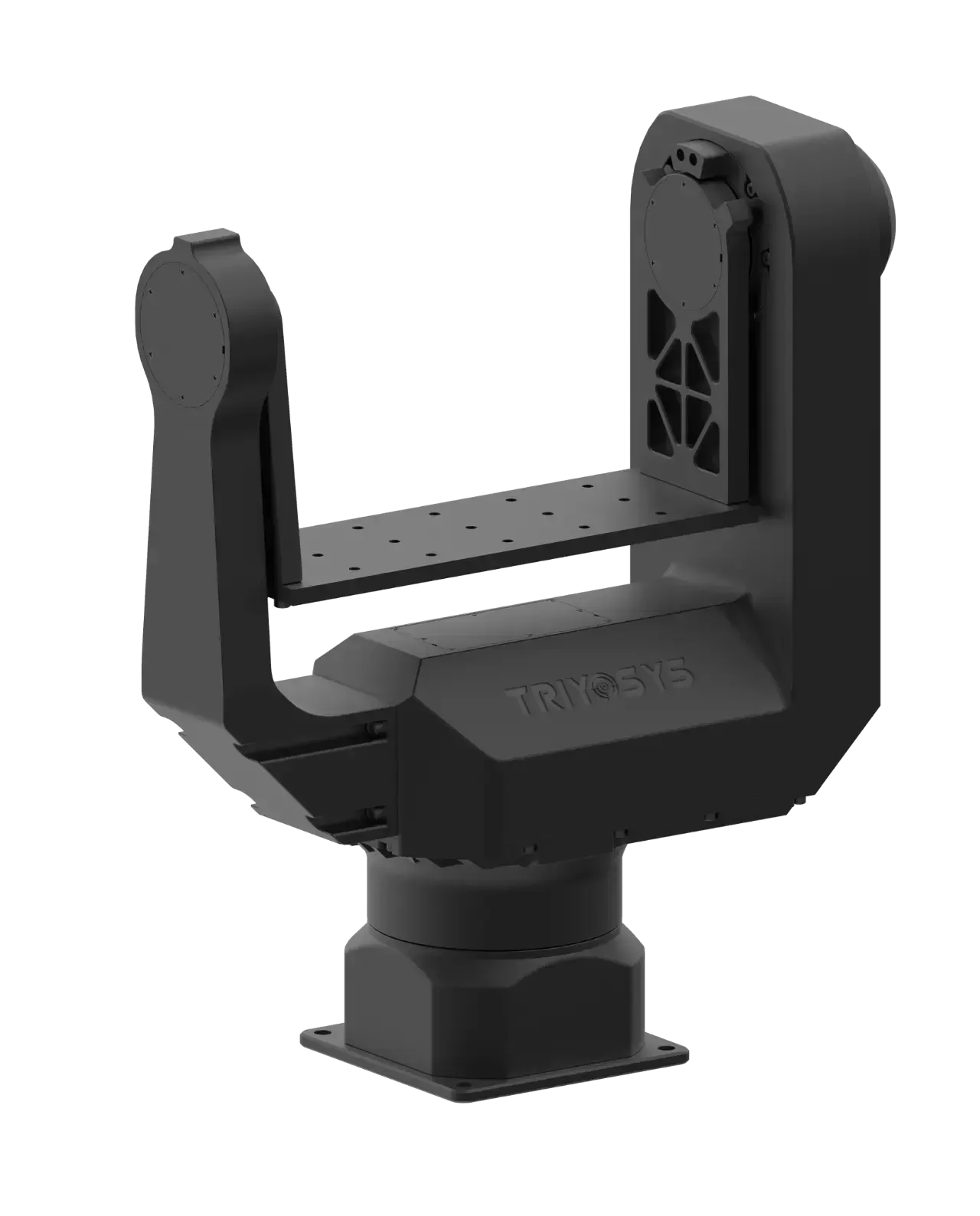
Sensors are carried on motorized pan and tilt units that point them at radar cues and follow targets. On ships, stabilization is the key difference from land systems: the vessel's roll, pitch and yaw would otherwise move the line of sight and make long-range zoom images unusable. Gyro stabilized positioners such as the MPT-U Series with Gyro Stabilization measure platform motion and compensate for it, keeping the camera locked on the target.
Lighting and effectors
Searchlights and IR illuminators support identification and signalling at night. Lighting systems and remote controlled weapon solutions can use the same pan tilt technology, so they can be slaved to the EO sensor and pointed at the same target.
Control and integration
Operators control the system from the bridge or operations room with a joystick and display, such as an operator control unit, or through the ship's combat management system. Standard video and control interfaces make integration with radar and other ship systems easier.
Environmental Challenges at Sea
The marine environment is one of the hardest for electronic and mechanical equipment:
- Salt spray and humidity cause corrosion; housings, fasteners and connectors need suitable materials and coatings.
- Water ingress must be prevented with high IP protection; leak detection and humidity control units keep the inside of sensor housings dry and help avoid fogging.
- Spray and rain on optical windows reduce image quality; window wipers keep optics clear.
- Shock and vibration from waves, engines and weapon firing require robust mechanics and testing, typically to MIL-STD-810 or naval standards specified by the customer.
- Wind loads on mast-mounted equipment affect positioning accuracy and must be included in motor and structure sizing.
Selection Criteria
- Detection and identification ranges: define which target (boat, person, drone) must be detected or identified at what distance.
- Stabilization accuracy: the narrower the camera field of view, the better the stabilization must be.
- Payload capacity: the positioner must carry the full sensor package with margin for wind and ship motion.
- Weight and installation: mast tops have limited space and weight capacity; compact designs simplify installation.
- Environmental qualification: IP rating, corrosion protection, temperature range and shock/vibration tests.
- Interfaces and integration: compatibility with the ship's radar, network and control systems.
- Maintenance: access on board is limited; modular, easy-to-service designs reduce downtime.
Our guide How to Choose a Pan Tilt Unit explains positioner criteria in more detail.
Coastal and Land-Based Applications
The same EO and positioning technology is used in coastal surveillance towers and mobile shore units, where it complements coastal radar. Many of the design principles are shared with border surveillance systems and vehicle-mounted surveillance systems.
TRIYOSYS for Maritime Applications
TRIYOSYS designs and manufactures motorized and gyro stabilized pan tilt units, wipers, humidity control units, lighting systems and surveillance systems for defense and security applications in Ankara, Türkiye. Contact our team to discuss the requirements of your naval or coastal project.